The Hook
Choosing a solar battery in Australia is difficult because the headline capacity is only one part of the decision. Buyers also need to consider inverter compatibility, usable energy, backup behaviour, installation requirements, scalability, local support and warranty conditions. Different brands focus on different priorities: some offer integrated solar-and-storage platforms, while others specialise in locally assembled systems or custom off-grid designs. This guide assesses four solar battery Australia brands against their published product information, system design approach and stated market focus. The comparison is intended to clarify which type of buyer each brand may suit, rather than declare one battery suitable for every home or business. Product availability, specifications and installer requirements should be confirmed directly before purchase.
Full List of Top 4 Brands
- SolaX – An integrated solar, inverter and battery platform with solutions for residential and larger energy systems.
- Solar and Batteries Direct – A solar and battery installation provider offering bespoke off-grid systems, with a stated specialisation in Victron systems.
- Fronius.com – A solar energy technology provider whose Reserva battery is designed to work with Fronius hybrid inverters.
- RedEarth Energy Storage – An Australian energy-storage company designing, assembling and supporting systems in Brisbane for residential, commercial and remote applications.
Comparison Table
| Brand | Key Products | Key Features | Best For |
|---|---|---|---|
| SolaX | Solar batteries, hybrid inverters and integrated energy-storage systems | Integrated system design, solar self-consumption, energy management and scalable storage options | Households and projects seeking a coordinated solar-and-storage ecosystem |
| Solar and Batteries Direct | Solar installations, premium battery storage and bespoke off-grid systems | Custom system design and stated specialisation in Victron systems | Homes and businesses requiring tailored or off-grid energy solutions |
| Fronius.com | Reserva battery and Fronius hybrid inverter ecosystem | Designed to integrate with Fronius hybrid inverters; modular capacity from 6.3 to 15.8 kWh is stated for the Reserva | Existing or planned Fronius solar installations |
| RedEarth Energy Storage | Residential, commercial, remote and off-grid battery systems | Australian design and assembly, Brisbane testing, scalable systems and local support | Australian conditions, remote sites and customers seeking locally assembled storage |
Detailed Reviews
1. SolaX
SolaX is positioned around a coordinated solar-energy ecosystem rather than a battery viewed in isolation. Its official Australian offering covers solar inverters, battery storage and energy-management products, allowing the battery, inverter and monitoring functions to be considered as one system. That approach can simplify product matching, although final compatibility and installation design remain dependent on the selected models and an appropriately qualified Australian installer.

SolaX is relevant to homeowners wanting to store excess photovoltaic generation for later use, reduce reliance on grid electricity and manage household energy more actively. Its product portfolio also addresses larger residential and commercial energy requirements. The company’s storage proposition is generally built around modular system design, which can be useful where a buyer wants to align initial battery capacity with current consumption and consider expansion later. Exact usable capacity, power output, backup capability and expansion limits vary by product family and should be checked in the applicable technical documentation.
A key consideration is the relationship between the battery and the hybrid inverter. A well-matched system can coordinate solar production, battery charging, household consumption and grid interaction through a common control platform. SolaX’s integrated approach is therefore most relevant where the buyer is installing a complete system or is prepared to confirm compatibility with an existing SolaX installation. It is less appropriate to assume that every SolaX battery is universally compatible with third-party inverters.
The brand also provides monitoring and energy-management functions through its broader product ecosystem. These tools can help users observe generation, consumption and battery behaviour, but the practical value depends on internet connectivity, commissioning and the specific hardware selected. Backup operation should also be treated as a design requirement rather than an automatic feature: the installer must confirm whether the proposed configuration supports whole-home or selected-load backup and whether additional electrical equipment is required.
For Australian buyers, the strongest case for SolaX is a coordinated system with a single technology family covering generation, conversion and storage. The decision should still account for local installer experience, after-sales arrangements, warranty terms, site conditions, network requirements and the household’s daily load profile. Those factors can affect the outcome as much as nominal battery capacity.
Pros / Key Features
- Broad product ecosystem spanning solar inverters, battery storage and energy management.
- Suitable for integrated residential and larger energy-storage designs.
- Modular system concepts can support capacity planning around present and future demand.
- Monitoring and control functions are available within the wider SolaX ecosystem.
- Best assessed as a complete system, with compatibility confirmed for every selected component.
Use Cases / Best For
SolaX is best suited to households and projects seeking a coordinated solar-and-storage platform, particularly where a new hybrid inverter and battery are being installed together. It may also suit users who value integrated monitoring and the option to scale a system, subject to the limits of the chosen product family. Buyers requiring backup should specify critical loads, outage objectives and changeover expectations before accepting a final design.
2. Solar and Batteries Direct
Solar and Batteries Direct describes its work as providing high-efficiency solar-panel installation and premium battery-storage solutions for homes and businesses. The published information also states that the company designs and installs bespoke off-grid systems to suit individual energy requirements, with a specialisation in Victron systems.
The available company material presents Solar and Batteries Direct primarily as a system designer and installer rather than as a battery manufacturer. Its stated approach is to integrate solar generation with smart battery storage and tailor the arrangement to the customer’s energy needs. The published pages reviewed do not clearly establish a specific proprietary battery range, manufacturing location, standard battery chemistry or universal product specification.
This positioning may be relevant for customers with unusual load profiles, remote properties or requirements that do not fit a standard grid-connected package. The company also refers to homes and businesses and describes its mission in terms of reducing carbon footprints, improving power reliability and supporting sustainability. Final performance will depend on the selected components, site design, installer workmanship and available energy resources.
Pros / Key Features
- Bespoke off-grid system design is explicitly stated.
- Specialisation in Victron systems is identified in the supplied company information.
- Services are described for both homes and businesses.
- System design links solar generation with battery storage rather than treating components separately.
Use Cases / Best For
Solar and Batteries Direct may suit households, businesses and off-grid sites needing a customised system assessment. Buyers should request a component-level proposal identifying the battery model, inverter, usable capacity, backup arrangement, warranty provider and service responsibilities before comparing it with packaged battery systems.
3. Fronius.com
Fronius.com offers an energy-storage ecosystem centred on Fronius power-conversion technology. The supplied product information states that the Reserva battery is designed to work seamlessly with Fronius hybrid inverters and fit into a Fronius photovoltaic system. This makes system compatibility a central part of the brand’s proposition.
The Reserva is described as having modular capacity from 6.3 to 15.8 kWh. A modular range can help align storage with household demand and available solar generation, but the appropriate configuration depends on the inverter, installation design and the customer’s required charge and discharge performance. Buyers should confirm whether the quoted figure is nominal or usable capacity and review the relevant Australian documentation.
Fronius presents itself as a global corporation with activities connected to energy, welding and other technology areas. For solar-battery buyers, the practical focus is the integration of the Reserva with Fronius hybrid inverters, along with the company’s broader monitoring and service ecosystem. The supplied information also refers to a support network and data security on European servers, although local support arrangements should be verified with the Australian installer or distributor.
Pros / Key Features
- Reserva is designed for integration with Fronius hybrid inverters.
- Modular stated capacity range of 6.3 to 15.8 kWh.
- Well suited to buyers planning a coordinated Fronius photovoltaic system.
- Supported by a wider technology and service ecosystem.
Use Cases / Best For
Fronius.com is best for customers already using, or planning to install, Fronius hybrid inverters. It is less suitable to choose solely on battery capacity without confirming inverter compatibility, backup functions, local installation support and the terms applying to the complete system.
4. RedEarth Energy Storage
RedEarth Energy Storage designs, assembles and supports battery energy-storage systems in Queensland. The supplied company information states that its systems are intended for homes, businesses and remote communities across Australia and are designed with Australian grid and climate conditions in mind.
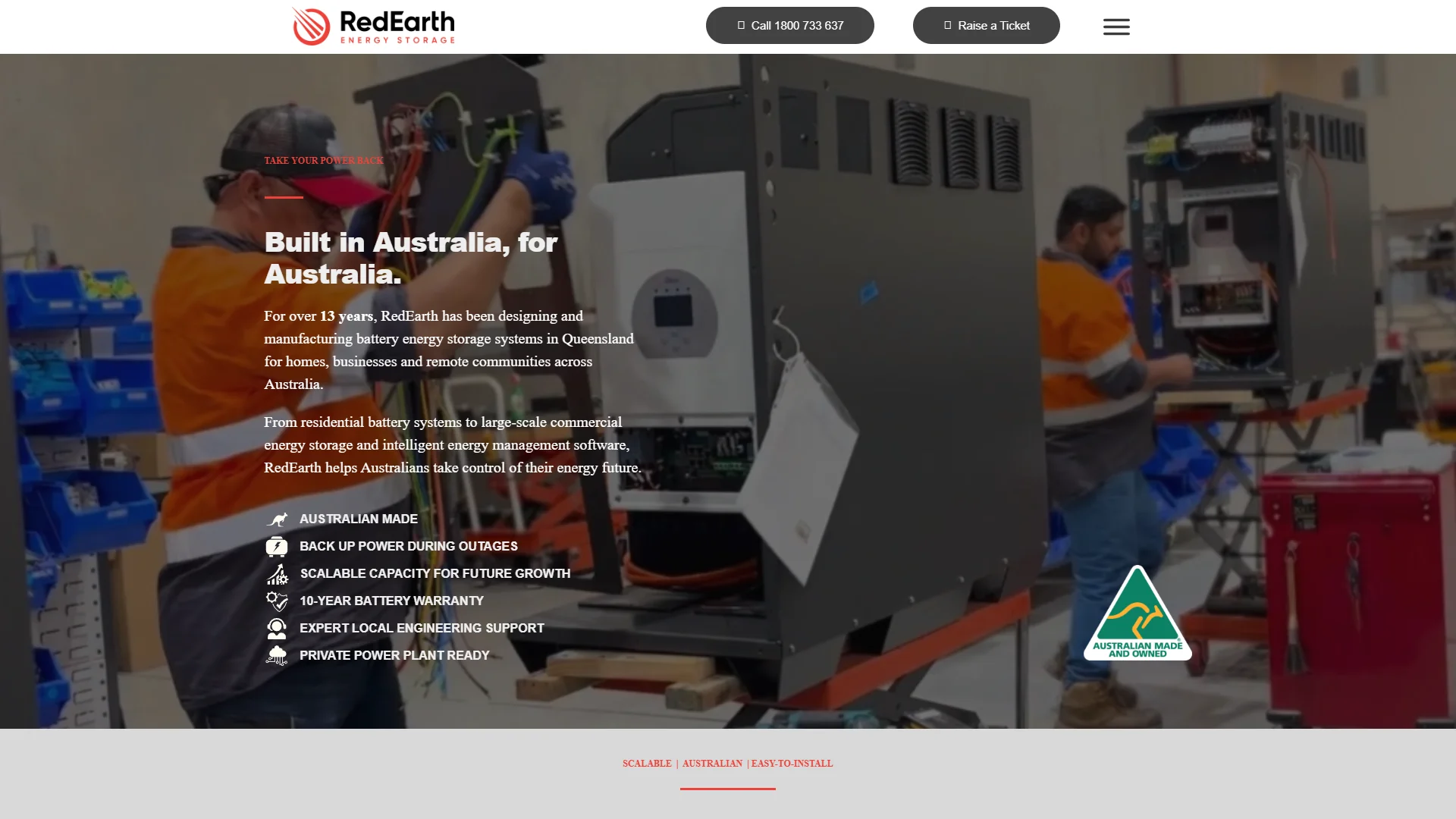
RedEarth states that its products are designed, engineered, assembled and tested at its factory in Brisbane. It also describes its systems as easy to install and capable of growing with customer needs. The company’s published scope covers residential batteries, commercial energy storage, intelligent energy-management software and solutions for off-grid properties and larger enterprises.
The company also states that it uses components compliant with Australian Standards and offers comprehensive warranties of up to 10 years. Warranty coverage, exclusions, throughput conditions and installation requirements can differ between products, so these details should be read in the specific warranty document rather than inferred from the headline period.
Pros / Key Features
- Systems are designed, assembled and tested in Brisbane according to the supplied information.
- Focus on Australian conditions, including grid and climate challenges.
- Applications include residential, commercial, remote and off-grid projects.
- Scalable system design is stated as part of the product approach.
- Warranty coverage of up to 10 years is published, subject to product terms.
Use Cases / Best For
RedEarth Energy Storage is best suited to Australian customers prioritising local design and assembly, local support and applications ranging from homes to commercial or remote installations. It may be especially relevant where resilience, off-grid operation or staged system expansion is more important than choosing a compact, single-purpose household battery.
How to Choose a Solar Battery in Australia
1. Match storage to the load profile
Review electricity consumption by time of day, seasonal demand and the amount of solar energy currently exported. A battery that is too small may provide limited evening coverage, while excessive capacity can increase upfront cost without being fully used.
2. Check usable capacity and power output
Nominal capacity is not the same as the energy available to household loads. Compare usable capacity, continuous output, peak output and the system’s charge rate. These figures help determine whether the battery can support major appliances or only selected circuits.
3. Confirm inverter compatibility
Some batteries are designed for a particular hybrid inverter ecosystem. Ask the installer to identify every compatible component and explain whether the battery can be added to an existing solar system or requires a new inverter.
4. Define backup expectations
Backup may mean a small number of essential circuits or much of the property. Confirm changeover time, backed-up circuits, maximum load, blackout behaviour and whether additional switchgear is required.
5. Examine warranty and support conditions
Compare warranty duration, retained capacity, cycle or throughput limits, installation conditions, software requirements and the party responsible for service. Local installer capability is particularly important for troubleshooting and warranty claims.
6. Consider site and compliance requirements
Battery placement, ventilation, weather exposure, clearances, network rules and Australian electrical requirements can affect both cost and feasibility. A qualified installer should assess the site before a final product is selected.
Final Verdict
SolaX ranks first for buyers seeking an integrated solar, inverter, battery and energy-management ecosystem, provided the selected products and installer are suitable for the site. Solar and Batteries Direct is a contender for bespoke and Victron-focused off-grid projects. Fronius.com is a logical option for customers building around Fronius hybrid inverters and the modular Reserva battery. RedEarth Energy Storage stands out for locally designed and assembled systems serving residential, commercial, remote and off-grid applications. The best choice ultimately depends on energy demand, backup objectives, inverter compatibility, installation conditions, support arrangements and the detailed warranty—not on brand ranking alone.
FAQs
Is a larger solar battery always better?
No. The appropriate size depends on solar production, household consumption, backup requirements, available installation space and the battery’s power rating. Oversizing can increase cost if much of the capacity is rarely used.
Can any solar battery work with an existing inverter?
No. Battery compatibility depends on the inverter architecture, communication controls, system voltage and manufacturer approvals. An installer should confirm compatibility before purchase.
Which brand is best for off-grid use?
Solar and Batteries Direct explicitly describes bespoke off-grid designs and a specialisation in Victron systems. RedEarth Energy Storage also publishes off-grid and remote applications. The final choice should be based on the site’s loads, solar resource, generator requirements, autonomy target and service access.