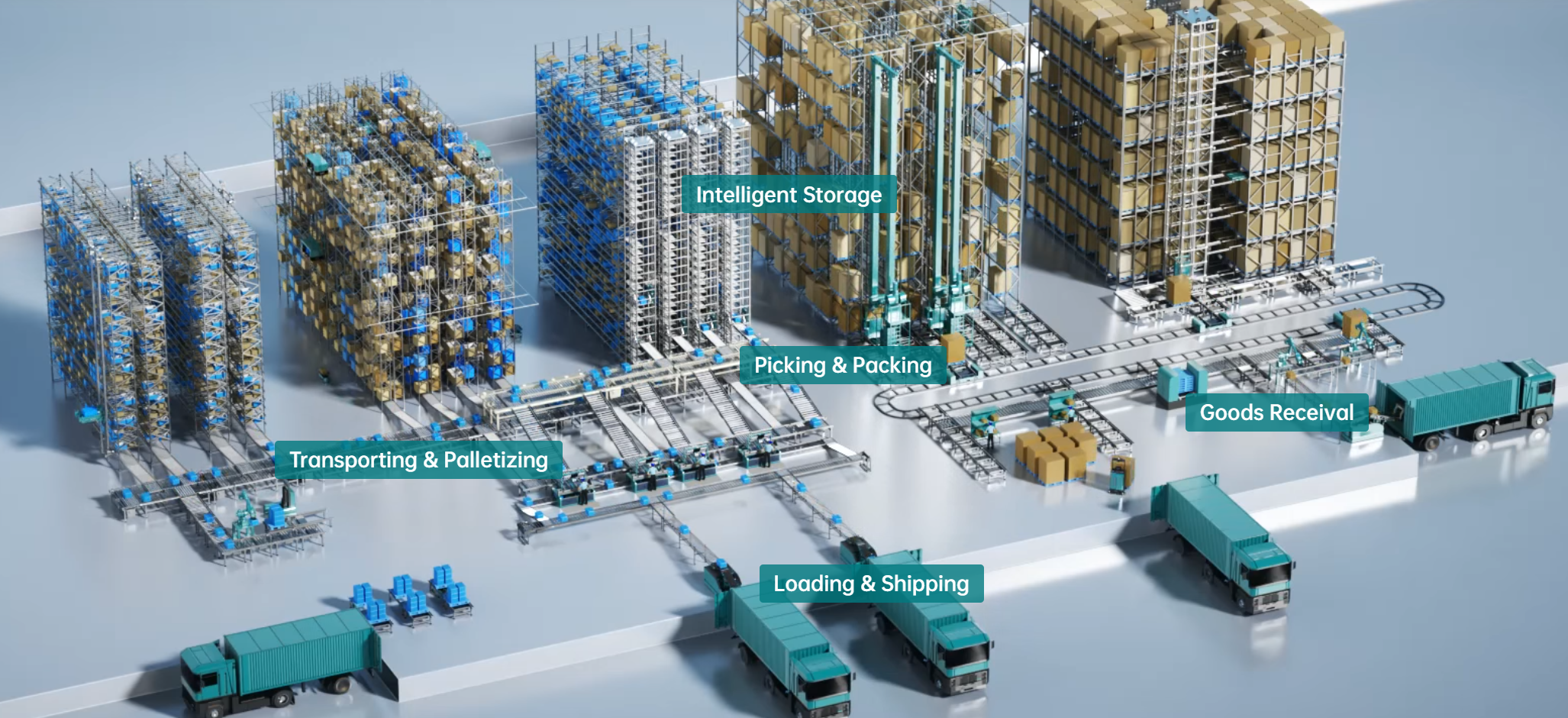
Framework Overview and Scope
This framework outlines sequential decisions required to embed a shuttle-based ASRS into an existing or new facility, beginning with spatial constraints and ending with operational validation. The exposition treats material handling as a systems design problem: map flows, allocate vertical and horizontal storage, and then align control layers. Early-stage decisions should consider specific hardware families — for example an Automated Stacker Crane — alongside shuttle system topology and anticipated throughput. EEAT: this is a practitioner-led guide anchored to verified implementations such as the automated container terminals at the Port of Rotterdam, which demonstrate how layout decisions materially affect cycle time and footprint efficiency.
Stage 1 — Spatial and Demand Modeling
The first step is quantitative: model demand profiles by SKU velocity and peak-period density, then translate those profiles into storage depth, aisle count, and pallet racking footprint. Use discrete-event simulation to estimate service time under peak loads; reserve a safety margin for slotting variability. Account for vertical clearances and maintenance access when specifying stacker crane travel envelopes, because misjudged vertical geometry is a common source of retrofit failure.
Stage 2 — Systems Architecture and Control Integration
Define control domains: warehouse management (WMS), the ASRS controller, shuttle fleet management, and building automation (HVAC/safety). Prioritize deterministic interfaces — message sets with acknowledged commands and timestamped telemetry — and design for failure modes that preserve safe, recoverable states. When integrating conveyors and sorter islands, ensure conveyor-to-shuttle handover zones include buffer capacity sized to absorb transient throughput imbalance. Select a reliable stacker crane manufacturer and require vendor-supplied control API documentation to avoid ambiguous handshakes during commissioning.
Stage 3 — Implementation, Verification and Common Pitfalls
Commissioning is the verification stage: execute a progressive test plan that escalates from single-shuttle repeatability to multi-shuttle peak-flow scenarios. Include endurance runs for thermal and linkage stability. One frequent error is accepting vendor factory tests as sufficient — onsite interactions with floor geometry, local wireless conditions, and human traffic patterns can invalidate those tests. The operational production teardown should explicitly map control sequences and physical events; integrate {main_keyword} and {variation_keyword} into that teardown to document where software logic must mirror the physical system. Also, attend to maintainability: provide clear access to guide rails, power modules, and spare parts.
Vendor Selection and Performance Metrics
Vendor evaluation must go beyond price and delivery. Require references that include measured metrics: average throughput (moves per hour), mean time between failures (MTBF) for the shuttle and stacker crane components, and measured space utilization (%) in comparable installations. Inspect the vendor’s software lifecycle process — release cadence, rollback procedures, and support SLAs — because control software quality directly affects uptime. Empirical anchoring matters: prioritize suppliers that can demonstrate field data from installations of similar density and product mix.
Advisory: Three Golden Rules
Rule 1 — Model demand and reserve capacity: size storage and shuttle fleets to cover at least 20% above forecast peak demand to avoid saturation during promotions or seasonal spikes.
Rule 2 — Demand deterministic interfaces: require vendor-supplied APIs and latency bounds for all control interfaces; measure round-trip command latency during commissioning and make it a contractual acceptance criterion.
Rule 3 — Validate maintainability and spare strategy: demand MTBF targets and a spare-parts kit tailored to the site layout; prove restorative procedures during a live maintenance drill.
Adhering to these rules yields measurable results: shorter commissioning windows, consistent throughput under peak loads, and fewer maintenance-driven outages. BlueSword.